Why Integrated Digital Mandates Are the Missing Link Between SEO and GEO Growth?
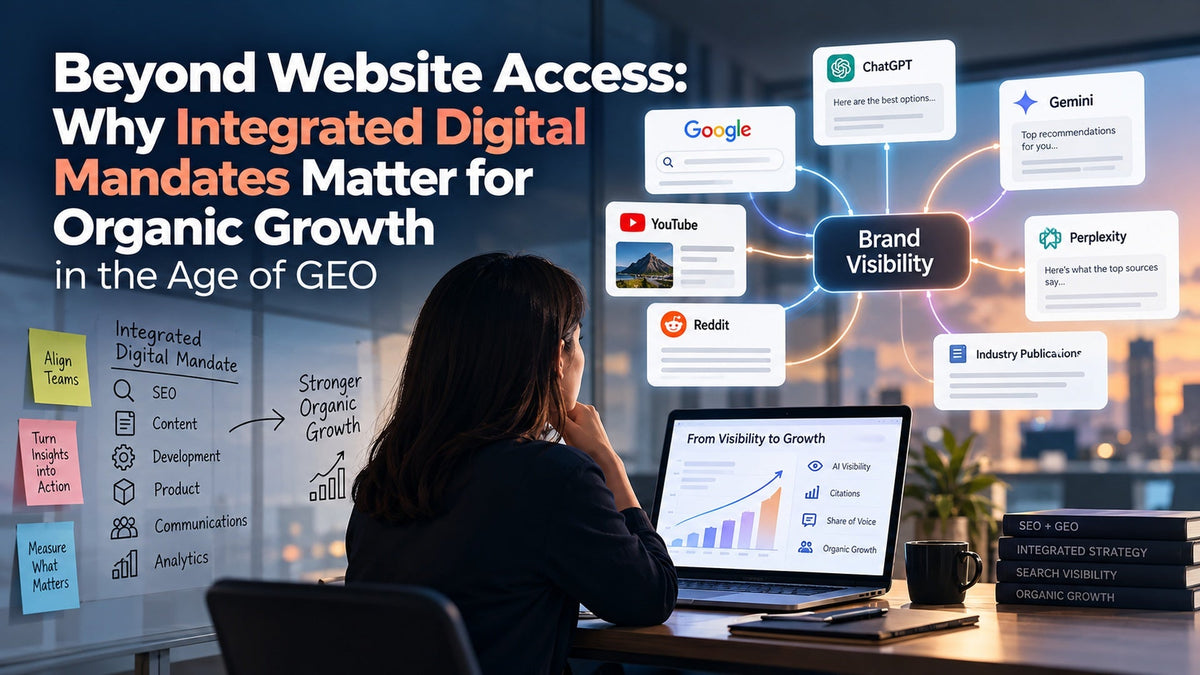
For years, organic growth followed a fairly predictable formula. Research the right keywords, optimise the website, publish relevant content, fix technical issues, improve rankings and track the clicks that follow.
And for a long time, this approach gave marketers a reasonably straightforward way to demonstrate performance.
But search has changed.
Today, someone researching a financial product, comparing holiday destinations or looking for the best solution to a specific problem might not begin with a Google search. They might ask ChatGPT, Gemini or Perplexity for a recommendation, compare the responses, explore third-party reviews and visit a brand's website only when they are closer to making a decision.
This changes the question brands need to ask.
It is no longer just about whether the website ranks for the right keywords. It is also about whether the brand appears in relevant AI-generated answers, whether its information is consistent across the digital ecosystem and whether it is considered when users compare competing options.
Enter Generative Engine Optimisation (GEO).
GEO builds on established SEO principles but introduces another dimension to organic visibility: how brands are represented, referenced and cited in AI-powered discovery experiences.
And here's where things get interesting.
What happens when an SEO or GEO partner has access to a brand's website but does not have the mandate, workflows or cross-functional support needed to implement changes across the wider digital ecosystem?
The answer is often a gap between identifying opportunities and realising their impact.
This is why integrated digital mandates deserve greater attention. They help align the teams, decisions and implementation processes that influence organic growth, while creating a more meaningful way to measure visibility beyond clicks.
Here are seven reasons why this approach is becoming increasingly important.
1. Website Access Does Not Automatically Translate into Organic Growth
Let's start with a distinction that often gets overlooked: access is not the same as control, and control is not the same as implementation.
An SEO partner may have access to Google Search Console, Google Analytics 4, the content management system and the technical documentation required to audit a website.
That is a useful starting point. But what happens when a recommendation requires approval from the product team, a development sprint, legal validation or changes to brand messaging?
Suddenly, the issue is no longer about identifying what needs to be fixed. It is about getting the right people to make it happen.
Consider a brand whose product pages contain outdated information. The SEO team identifies the issue and recommends an update. However, the product team owns the information, legal needs to approve the changes, and development controls the publishing process.
Even if everyone agrees with the recommendation, the update can remain pending for weeks.
Meanwhile, the original content continues to exist.
In traditional SEO, this can delay improvements to relevance, usability and organic performance. In GEO, inconsistent or incomplete information can also make it harder to present the brand clearly across relevant discovery experiences.
An integrated digital mandate helps address this disconnect by establishing clear ownership, approval processes and implementation timelines.
The takeaway: Access helps identify opportunities. An integrated operating model helps turn those opportunities into action.
2. GEO Depends on More Than What a Brand Publishes on Its Website
A technically sound website is essential, but it is not the entire digital ecosystem through which a brand is discovered.
AI-powered search experiences may draw on different combinations of brand-owned pages, independent publications, product comparisons and other available sources, depending on the platform and query.
This creates a challenge for brands that focus exclusively on their own websites.
Imagine a banking brand that has updated its website with accurate product features, eligibility criteria and fees. However, older comparison articles continue to describe outdated offerings, while community discussions contain conflicting information.
The brand may have improved its owned content, but the wider information environment remains inconsistent.
Or consider a travel brand with detailed destination pages but limited useful coverage of the questions potential travellers ask when comparing itineraries, shore excursions or onboard experiences.
In both cases, website optimisation is necessary, but it may not be sufficient to address the entire visibility challenge.
An integrated digital mandate can bring SEO, content, product marketing, communications and customer-facing teams together to identify information gaps, improve owned content and pursue appropriate opportunities to strengthen the brand's presence across relevant external sources.
This does not mean a brand can control independent publishers or guarantee AI citations. It means it can take a more coordinated approach to the factors within its influence.
The broader principle also connects with Search Everywhere Optimisation: audiences discover brands across different platforms, so organic growth planning should account for the touchpoints that matter to their decision-making journeys.
The takeaway: GEO is not just about making a website easier to find. It is also about making the brand easier to understand and evaluate across relevant digital touchpoints.
3. Fragmented Digital Teams Can Create Fragmented Search Visibility
Most brands do not lack digital activity. They often have plenty of it.
The website team manages technical changes. The content team publishes blogs. The PR team works on editorial coverage. The social team monitors audience conversations. Product marketing owns positioning, while analytics teams report performance.
The problem is that these activities may operate independently, even when they influence the same organic growth objective.
Here are three common examples.
The SEO team identifies a recurring customer question, but the content team has no space in its publishing calendar to address it.
The PR team secures relevant third-party coverage, but the SEO team is unaware of it and cannot incorporate the opportunity into its visibility analysis.
The product team updates an offering, but website content, FAQs and other owned information remain outdated.
None of these problems necessarily comes from poor execution by an individual team. They emerge when the operating model does not connect the work.
An integrated digital mandate creates a shared framework for priorities, dependencies, approvals and performance reporting.
It also makes it easier to distinguish which team needs to act, what needs to change and how the impact should be evaluated.
This is especially relevant for large brands with multiple products, markets, business units and approval layers.
The takeaway: Organic growth improves when digital teams operate towards a common objective rather than managing disconnected deliverables.
4. The Distance Between Recommendation and Implementation Matters More Than Ever
A strategy can be excellent on paper and still deliver limited impact if the recommended changes never reach implementation.
This is one of the less glamorous but more consequential challenges in digital marketing.
An audit identifies technical issues. A content gap analysis reveals missing pages. Prompt research shows that competitors are appearing in important AI-generated answers. Recommendations are presented, discussed and approved.
Then the implementation queue fills up.
Development resources are unavailable. Legal reviews take longer than expected. Product stakeholders request additional validation. Content approvals move into the next cycle.
The opportunity remains open, even though the strategy is already in place.
An integrated digital mandate can improve this process through a few practical mechanisms:
Shared prioritisation: Rank recommendations by potential impact, business relevance, effort and dependencies.
Named ownership: Assign an accountable team or stakeholder to every implementation item.
Defined timelines: Establish realistic turnaround times for technical changes, content approvals and publishing.
Escalation mechanisms: Identify how high-priority blockers will be resolved.
Post-implementation validation: Confirm that changes were deployed correctly and measure the relevant outcomes.
For GEO, this can be particularly useful because recommendations may involve more than conventional on-page optimisation. They can require updated product information, stronger explanatory content, clearer brand positioning or coordinated external communications.
Of course, an integrated mandate cannot remove every dependency. Nor can it guarantee that a particular change will produce an AI citation.
What it can do is make execution more systematic and reduce avoidable delays.
The takeaway: The value of an organic growth strategy depends not only on the quality of its recommendations but also on the organisation's ability to implement them.
5. GEO Pitches Need to Move Beyond Clicks as the Only Measure of Success
Here is where the conversation around organic growth becomes particularly interesting.
For years, clicks have been one of the most familiar ways to communicate SEO performance. Rankings improve, impressions increase, users click through to the website, and marketers track the resulting traffic and conversions.
These metrics remain important. But when the objective expands to include AI search visibility, clicks alone can provide an incomplete picture.
A brand might appear in an AI-generated answer, be cited as a source or be included in a product comparison without generating an immediate website visit.
That appearance may contribute to awareness or consideration, although the actual effect depends on the context and cannot be assumed from the mention alone.
If the engagement is intended to improve GEO visibility, the performance framework should measure that objective directly.
Relevant indicators include:
AI answer presence: How often the brand appears in a defined set of AI-generated responses.
AI citation frequency: How often the brand's website or other sources are cited.
Prompt coverage: The proportion of tracked prompts where the brand appears.
AI share of voice: The brand's visibility relative to competitors across a defined prompt set.
Brand recommendation rate: How often the brand is recommended in relevant commercial scenarios.
Traditional organic impressions: How often eligible pages appear in conventional search reporting.
Organic clicks and conversions: Whether measurable discovery translates into website visits and business outcomes.
These indicators should be reported separately because they measure different things.
An AI-generated brand mention is not necessarily a citation. A citation is not necessarily a recommendation. And neither should automatically be counted as a traditional search impression.
This distinction matters when setting expectations with stakeholders.
A GEO proposal should lead with the outcomes it is designed to influence, rather than forcing every engagement into a traffic-first reporting framework.
The takeaway: If visibility is the objective, measure visibility. Retain clicks and conversions as complementary indicators of traffic and business impact.
6. Visibility Projections Need a Clear Baseline, Not Just an Ambitious Number
Moving beyond clicks does not mean replacing one simplistic target with another.
A GEO pitch that promises a specific number of AI mentions or a fixed percentage increase in visibility without a defensible baseline is not necessarily more sophisticated than a traffic-only proposal.
AI-generated responses can vary by platform, query, model, time and context. Results from a limited prompt sample cannot automatically be extrapolated to the entire AI search market.
This makes the methodology behind a projection just as important as the projection itself.
A credible GEO forecasting framework should include five steps.
Step 1: Define the prompt universe
Identify the informational, comparative and commercial questions relevant to the brand's products and target audiences.
Step 2: Establish the baseline
Test the defined prompts across relevant AI platforms and document brand mentions, citations, competitors, cited sources and response accuracy.
Step 3: Identify the visibility gaps
Determine where the brand is absent, inaccurately represented or less visible than relevant competitors. Investigate whether the gaps relate to content, technical accessibility, product information or the wider information environment.
Step 4: Build scenarios
Develop conservative, expected and ambitious scenarios where sufficient data exists. Document the assumptions, dependencies and limitations behind each forecast.
Step 5: Track progress consistently
Repeat the assessment using a documented methodology and monitor changes in visibility, competitor presence and relevant traffic outcomes.
This allows the brand to assess whether the strategy is moving in the intended direction without treating uncertain outcomes as guaranteed results.
It also creates a stronger connection between the mandate, the work being delivered and the performance being reported.
The takeaway: GEO projections should be visibility-led where appropriate, but they must remain evidence-based, transparent and realistic.
7. Integrated Digital Mandates Create a Stronger Foundation for Long-Term Organic Growth
The strongest argument for integrated digital mandates is not that every digital activity must be controlled by one agency.
It is that organic growth depends on multiple interconnected factors, and those factors need to be coordinated if the strategy is to work effectively.
A useful integrated mandate should bring together five workstreams.
- Workstream
- Primary focus
- Example of a measurable output
- Technical SEO
- Crawlability, indexability, site architecture and structured data
- Resolution of priority technical issues
- Content and intent
- Keyword coverage, customer questions and useful content
- Improved coverage of priority search intents
- Brand and external visibility
- Relevant third-party coverage and accurate brand information
- Changes in tracked citations and brand mentions
- Implementation and governance
- Ownership, approvals and delivery timelines
- Reduced backlog of priority recommendations
- Measurement and optimisation
- SEO performance, GEO visibility and business outcomes
- Trends in visibility, traffic and conversions
The exact scope will vary by brand, industry and business priorities. Some activities will remain with internal teams or specialist partners, and independent sources will always sit outside the brand's direct control.
What matters is that the responsibilities, dependencies and measurement framework are clear.
This creates a more coherent way to manage organic growth as search evolves. It also gives leadership a better understanding of what the digital mandate is expected to influence, which changes are within the team's control and how success will be evaluated.
The takeaway: Integrated digital mandates do not guarantee organic growth. They create a more coordinated operating environment in which organic growth opportunities can be identified, implemented and measured more effectively.
So, What Should Brands Change About Their Organic Growth Strategy?
The shift towards GEO should prompt brands to revisit how they structure their digital mandates, not simply add another deliverable to an existing SEO scope.
Before committing to a GEO engagement, brands should ask:
Are we measuring AI search visibility separately from conventional search performance?
Do we have a documented baseline for the prompts and platforms that matter to our audience?
Can our SEO or GEO partner access the information and stakeholders required to act on its recommendations?
Are technical, content, product and communications teams working towards shared priorities?
Do we have a defined process for implementing and validating high-priority recommendations?
Are visibility projections supported by a clear methodology and realistic assumptions?
Can we connect organic visibility with traffic, qualified leads and conversions wherever the evidence permits?
These questions help distinguish a narrowly scoped optimisation exercise from an integrated organic growth strategy.
The goal is not to expand every mandate indefinitely. It is to ensure that the scope, permissions, resources and performance indicators are aligned with the outcomes the brand actually expects.
Conclusion: Organic Growth Is No Longer Just About Optimising the Website
SEO remains foundational. GEO expands the conversation. And the broader evolution of search reinforces the need to think beyond isolated channels.
But none of these developments changes a fundamental truth: identifying an opportunity is only the beginning.
A brand may have an excellent website, a comprehensive keyword strategy and a well-researched GEO roadmap. Yet, without coordinated decision-making and implementation, many of the opportunities identified by that strategy may remain unrealised.
Integrated digital mandates help close that gap by connecting website optimisation with the wider set of teams, information sources and processes that influence organic visibility.
They also create a stronger foundation for performance measurement. Instead of relying exclusively on clicks, brands can assess the visibility outcomes they are trying to influence, including AI answer presence, citations and share of voice, while retaining traditional SEO and business metrics as complementary measures.
The aim is not to replace one metric with another or to treat every digital channel as interchangeable.
It is to build an organic growth strategy that reflects how discovery actually happens and gives teams the ability to act on what they learn.
Because in the age of GEO, website access can help you identify the opportunity. An integrated digital mandate helps you act on it.
And that distinction could make all the difference between an organic growth strategy that looks comprehensive on paper and one that is equipped to deliver meaningful progress.
Frequently Asked Questions
1. What is an integrated digital mandate?
An integrated digital mandate aligns the teams, activities, resources and workflows that influence a brand's digital performance. For SEO and GEO, this may include technical development, content, product marketing, brand communications, external visibility and analytics.
2. Why is website access alone insufficient for GEO?
Website access allows teams to analyse and optimise owned digital assets, but some improvements depend on other stakeholders, while broader brand visibility may also be influenced by external sources. An integrated mandate helps coordinate the decisions and implementation required across these areas.
3. How does GEO support organic growth?
GEO aims to improve how a brand is represented in relevant AI-generated answers through useful content, technical accessibility, accurate information and appropriate authority-building activities. Its contribution to organic growth should be assessed through defined visibility indicators and, where measurable, downstream traffic and business outcomes.
4. Should GEO performance be measured through clicks or impressions?
Neither should be treated as the universal primary metric. AI answer presence, citations, prompt coverage and share of voice can be more directly aligned with a visibility-led GEO objective. Traditional search impressions, clicks, traffic and conversions remain valuable for measuring other stages of discovery and business impact.
5. What is the role of Search Everywhere Optimisation in an integrated digital strategy?
Search Everywhere Optimisation provides a broader perspective on how audiences discover brands across traditional search engines, AI experiences, social platforms and other relevant digital touchpoints. It complements an integrated digital strategy but does not replace the need for specific SEO and GEO objectives, implementation plans and measurement methods.
6. Can an integrated digital mandate guarantee better organic rankings or AI citations?
No. An integrated mandate can improve coordination, implementation and measurement, but rankings and AI-generated answers depend on factors that no single brand or agency fully controls. Its value lies in creating a more effective process for acting on organic growth opportunities.
Want this working for your brand?
Book a strategy call